


COEO’s MAKE PEACE WITH WINTER 2026
The Council of Outdoor Educators of Ontario is excited to invite you to attend Make Peace with Winter (MPWW) at Camp Kawartha, January 23-25, 2026!
Your 2026 COEO Make Peace with Winter Organizing Committee is hard at work on another amazing weekend packed full of professional connection and development, experiential learning, and winter fun! Make Peace with Winter is a retreat-style conference for educators interested in learning how to share (and embrace!) the outdoors with their students in the coolest of seasons.
Join us as we learn, share, and laugh with kindred spirits from across the province and beyond. We’ll enjoy delicious food throughout the weekend and engage in opportunities to connect. Embracing the experiences of the weekend will support you in feeling rejuvenated and leaving with new ideas and resources to enhance your professional practice. The final ingredient for a perfect winter weekend is you! Our host site, Camp Kawartha, is ready to welcome everyone.
Take time this winter to share connections and support one other. We encourage you to spread the word about MPWW and invite folks who you see working to build community in the outdoors who may not yet be a part of COEO.
MPWW 2026 – REGISTER HERE!
COEO is committed to reducing barriers to access. For those for whom cost is a barrier, we invite you to apply for a bursary to off-set conference registration costs. Please click here to apply for the bursary.
Transforming Education for Eco-Centric Change
What role is education called upon to play in this time of accelerating ecological catastrophe driven, in no small part, by a deep disconnection of kinship between humans and the rest of the natural world? It is, we propose, nothing less than to find ways to enact the profound re-creation of our society; to establish a different set of values and ways of living toward them. Each one of us, as educators (of which we all are, in myriad capacities), is thus called upon to rebel – to refuse the systems and practices which have brought us to the brink and to seek different (sometimes new, sometimes old) ways instead. An act of radical hope, the question is not what is possible, but rather what is worth doing, even if we fail? It is a fundamentally educational act: the planting of a tree on the last day of the world.
A bold, provocative, far-reaching theme. Let’s break it down.
- Transforming: changing fundamentally, in an active and ongoing way (hence the suffix ‘ing’), the base-level. A radical process of questioning and re-orienting.
- Education: strip away the blackboards and chalk, the desks and assignments, the canoes and paddles. What is left? Kneel close, peer behind the bushes, and you will discover that most wonderful of things. A process and a practice, a theory and an action. A foundationally hopeful attempt to discover good ways of being human in this world, and a desire to share in those ways with others.
- Eco-Centric: moving toward a renewed kinship with the natural world wherein the flourishing of all living and natural beings and, crucially, the relationships between them, is the driver of human action.
- Change: an active process aimed toward re-thinking not only what we might start doing more of, but also what we might start doing less of, or stop doing altogether.
More than a conference theme, Transforming Education for Eco-Centric Change is a long-term philosophical project – a process and an aim – toward which we hope this year’s Make Peace with Winter can make a substantial contribution. To this end, we are opening our conference to two types of workshop proposals, both of which will be intermingled during the various workshop blocks and available for anyone to sign-up and attend.
Types of Proposals:
1) Practical workshops: the first are those practitioner workshops, grown from hard-earned insights from years in the field, on the front lines of transforming education toward an eco-centric world.
2) Research and/or theory: the second are more novel to COEO, aimed explicitly at bringing theoretical insight to the table and merging it with pedagogy and practice. We invite any students (at the undergraduate, masters, or PhD level), professors, practitioners, Indigenous knowledge keepers, and anyone else with ideas to share to submit papers which fit under the general theme of the conference. These could be essays written for classes, previously published ideas re-worked to fit the conference theme, or new papers written explicitly for this conference. If selected, these papers will be published in a special issue of COEO’s academic journal Pathways: The Ontario Journal of Outdoor Education, as well as having the author present a workshop at the conference.
Unlike most academic conferences and paper submissions, COEO is a unique opportunity for academics to present their ideas to an explicitly practitioner audience of people who work in the diverse field of education day-in and day-out. For this reason, while the papers themselves should be academic in nature, the workshop about the paper should focus on the dissemination of knowledge and putting theory into practice. Workshop proposals should outline how the paper and its ideas will be presented in this way. Get creative, as COEO is a community-based organization and the conference theme values being radical. Usual formal rules of academic presentation do not apply here. We also invite the submission of papers for which the author wants to contribute to the Pathways special issue but either cannot attend the conference or does not want to present.
We especially urge students to submit papers, as this is a wonderful opportunity to gain experience in academic publishing, presenting, and, uniquely, disseminating knowledge outside the academic world. All with the aim of making real, profound cultural changes on what is certainly the overriding issue of not only our time, but any time in our species’ history.
Soar high, dive deep, go bold, and be radical. Our conferences are nothing without their presenters, and we cannot wait to see what you submit in response to the urgent need of Transforming Education for Eco-Centric Change. You have much to offer.
We look forward to seeing you in joyous, cozy, conspiring communion at Camp Kawartha from January 23rd – 25th for COEO’s annual Make Peace with Winter 2026.
In hope and wonder,
Devin Mutić, Rayanna Santiago, and Lee McArthur, conference Co-Chairs
The Trading Blanket
Now an annual MPWW tradition! To participate in the Trading Blanket activity on Friday evening – bring an item to trade! Each participant brings 1 item they would like to trade. The item should be something of utilitarian value or beauty. The item should be functional and something you are willing to give up. A blanket is placed in the middle of the room. All participants start by sitting around the blanket, with their trade items sitting on the floor in front of them. Participants may circulate around at first to see what items are up for trade. When the trading begins, one person volunteers to put their item in the middle of the blanket. Anyone wanting the item can move their trade items forward in offering. The owner of the original item examines the goods offered for trade and decides whether to make a trade or not. If a trade is made, there are usually pleasantries exchanged, and the group moves on to the next person’s item. If no trade is made, the owner will remove it from the blanket, thank those who made offerings, and they may consider making a trade later in the evening. Get creative! Items we’ve seen on the trading blanket range from homemade preserves to traditional tools, unwanted clothing (still in good shape), rides home, works of art, jewellery, nature artifacts, and books. The blanket trading can go on for a long time, so participants are encouraged to limit the items they offer for trade and come and go as they please. Participants have found these interactions much more meaningful than simply shopping for wanted items. This year’s trading blanket will be a timed event. Happy trading!
Used Gear Silent Auction to Support the Bursary Fund
Have you recently upgraded or replaced your beloved outdoor gear? Do you have old camping stuff that could use some TLC or a new loving home? Do you have a pile of “needs repair” gear that you know you’ll never get to? We are planning a used gear auction at the upcoming Make Peace with Winter conference, and we are looking for donations of new/well-loved/no longer needed by you gear! All of the money raised will go to COEO’s bursary fund to help us broaden our community and increase access for those who need some extra financial support. Plus, you’ll know that the donated gear will all be put to excellent use within our outdoor community! We will also happily accept any other non-gear donation items to add to the auction if you have anything in mind – we especially love to see things lovingly made by our COEO pals (Crochet?! Pottery?! Cards!? Paintings?! Maple Syrup!? You name it!) and feel free to reach out if you have something you aren’t quite sure about! If you have anything you’d like to donate, please bring your donations directly to MPWW and find any committee member when you arrive! Please feel free to also email conference@coeo.org if you have any questions.
Register Today!
Conference Poster
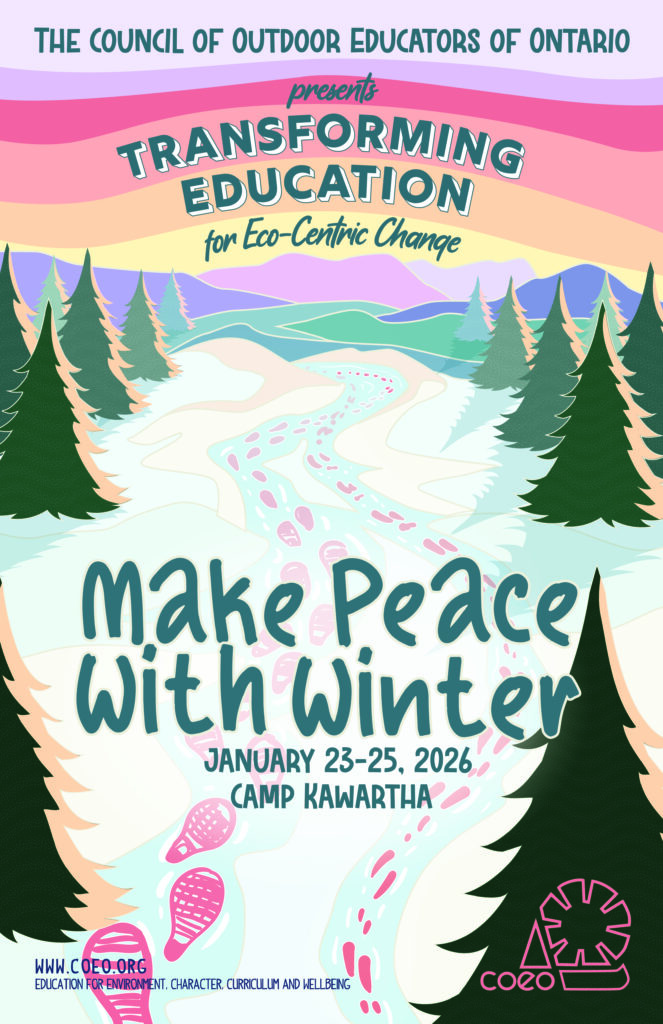
Have you seen the OFFICIAL 2026 MAKE PEACE WITH WINTER CONFERENCE POSTER yet? (see below) Download a copy for your very own, print and display it with pride in your centre, school, camp, store, park, staffroom, office or outhouse!
A Brief History of Make Peace with Winter
The very first Make Peace with Winter gathering took place at the Leslie M. Frost Centre in Dorset, Ontario on the weekend of February 1-3, 1980. The conference was a cooperative effort between the Council of Outdoor Educators of Ontario and the Ontario Teacher’s Federation and was billed as an event primarily for teachers (K-13). The conference took place annually for many years afterwards, but then during the mid to late 90’s was only offered sporadically, and then eventually vanished from the COEO calendar in 2004. Through determination and hard work this once beloved COEO retreat-style conference has returned. Deb Diebel, COEO Past President, was instrumental in reigniting the Make Peace tradition when she and a group of colleagues from the Bluewater Outdoor Education Centre hosted Make Peace with Winter in January of 2012 on the Bruce Peninsula. This collage is a collection of various Make Peace with Winter advertising and posters that were used throughout the 80’s and 90’s.
